The best time to train your dog!
November 20, 2009
The best time to train your dog or mine 🙂 is when he/she is hungry and when they have been alone for a time, for example if you have been out for a time, preferably 2 hours or more.
Titbit training is by far the easiest method of training any dog, it only goes wrong when the food is withdrawn to early in the learning process or when the dog controls when he/she gets the titbit, to be sure they do not made sure you are giving the food rather than the dog taking the titbit. For maximum results the dog must want the food, if they have just been fed they will not be so keen, even if the titbit is something exotic like chicken or sausage!
By far the most important factor, one that is often overlooked by pet owners is to train the dog when it is not saturated with your company, for me this means that I will shut my dog in my utility room to artificially create his want to be with me, this makes him 50% keener to please me when I start training him. Whereas the dog that has just been having a cuddle on your lap will have much less motivation to work for you, why should he/she?
Helping to keep the mud out!
November 17, 2009
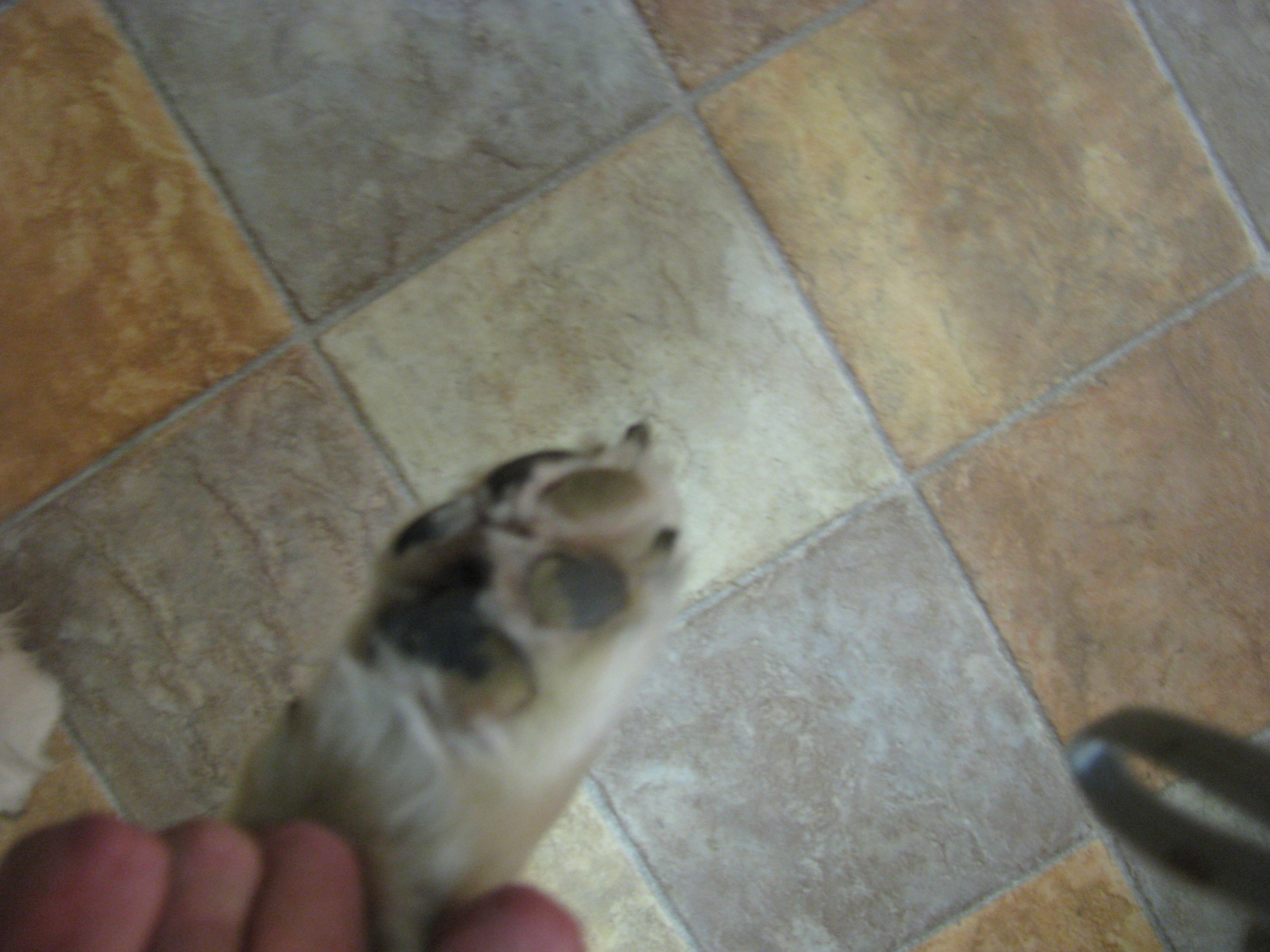
The finished foot!
Pie had a trim today, he is of the age (3) when he is getting extra hairy feet! Some breeds get hairier all over but the feet are the part that brings the mud and water in from outside in the winter!
I really should have taken a before picture so that you could witness the transformation, but I can show you a trimmed foot!
Last winter I only had to do his feet once and they kept neat, this is already his second trim! He didn’t mind too much, though his feet are a bit ticklish which makes him twitch from time to time, I use blunt ended scissors to ensure I don’t stab him!
Dogs, babies and children and how to be sure they all get along!
November 11, 2009
Dogs, babies and children
Having a new baby is an exciting and a scary time for Mum and Dad, only new parents can really know how precious that new baby is when you first bring them home, and no matter how loved your dog is, they now rank second in your affections to this new person in your life, coupled with the fact that all of our human instincts are to protect and keep this baby safe. Suddenly your family pet can seem very threatening to your family added to this is the guilt you are likely to be feeling at this change in loyalty!
The reality is that with some careful management and understanding this phase of your dog’s life can go reasonably smoothly.
- Ø New mother and father to start using some baby products a few weeks before the due date, for example soap or baby lotion, to accustom the dog to the new smells of a baby
- Ø Prepare your dog by changing appropriate daily events for example if sleeping in your bedroom start training the dog to sleep in the kitchen or utility room well in advance of babies due date
- Ø It is likely that as a new Mother you will want to have private time with your baby, start accustoming the dog to being shut in another room away from you for sensible time slots say 1 hour two to three times a day, if you are at home a lot.
- Ø Teach your dog a half hour down stay in your living room and commit to daily practice to adjust your dog to be trained to be in the same room as you without having your attention
- Ø If a crate will suit your lifestyle, introduce this well in advance of your babies arrival, say at least 3 months before the due date or sooner if possible
- Ø When you first bring the baby home once you feel comfortable bare the babies feet for the dog to sniff or lick, this will satisfy the dog’s curiosity and he/she will then lose interest in the baby.
- Ø Do put your dog away when you need time alone with your new baby, this is a precious time and it is important for you to enjoy yourself as much as possible, your dog will be fine.
- Ø Do not feel guilty that the time you used to have for your dog now has to go to the baby, this phase will pass and you will soon want to escape for a dog walk.
- Ø You and your dog’s life has changed for good now, your dog will adjust to this much faster than you!
- Ø Babies are more important than dogs and that is okay!
- Ø Never never leave a baby or child alone with a dog, however trusted the dog is!
Older babies
As your baby grows so will the relationship between the baby and dog develop, luckily around the time babies start crawling they also start to throw food around, your dog will soon become a very faithful companion to your child as a result!
However with time new rules must be enforced:
- Ø The dogs sleeping area is a no go for any children, this may mean using a baby gate in a doorway to protect the dog or putting the dog in a crate.
- Ø The child’s sleeping area is a no go for the dog, or if not this will mean child and dog are alone unsupervised.
- Ø Do stop your child from pestering the dog, such as when the dog is asleep or minding its own business, do not let your child approach, or your dog may have to tell the child off.
These rules are necessary for your dog to respect your child as a human and therefore higher in the pack than them. As the child grows we can encourage the dog to respect the child further by involving the child in the training and feeding of the dog.
- Ø While supervising give your child food to place in the dogs bowl for the dog to eat, thereby teaching the dog that the child is not a threat at feed times.
- Ø Teach your child how to use a hand signal with food to get the dog to sit and/or go down.
- Ø Teach your child how to play retrieve with the dog, if your dog likes this game.
The biggest reason dogs see children as not higher than them in the pack is because they see adults ordering children about, much as they do dogs or maybe more so, as in my childhood, by having clear rules and boundaries we can keep our children and dogs safe.
Crate Training a Dog
November 9, 2009
Why puppies/dogs like crates:
Used well, crates become a place of sanctuary and refuge for puppies and older dogs, somewhere to hide when the hustle and bustle of home life gets too much and the puppy or dog needs to rest without fear of being trodden on or pestered by people! In the wild a dog would dig a hole in the ground, no larger than themselves to rest!
Choosing a crate:
A crate needs to be large enough for the adult dog to stand up, turn around and lie down full length, any bigger and the crate will not only become less practical for you, but will not give a cosy house for your dog.
The advantages of using a crate:
- Aids and speeds house training
- Prevents destruction of the home and therefore learning bad habits
- Can be used for car travel
- A travelling house that will give your pet safety and you peace of mind when you visit others homes
- Teaches the dog to lie down and sleep when you are out
Being kind:
- Water must be available (water bowls with brackets that fix to the side of the cage are available from pet shops)
- Maximum time in the crate overnight and for up to 5 hours during the day will be tolerated comfortably by dogs of most ages
- Choose the location of the crate carefully, dry and warm, but not in a conservatory in full sun
- Follow the steps below to ensure your puppy will not be distressed when left alone or shut in the crate
Training Steps:
- Bring the cage into the home, you can start in the living room, where the cage is in the early days is not important, start somewhere convenient to training, once the training is complete your dog will be happy in his/her crate where ever it is!
- Put some comfy bedding in the bottom, preferably familiar bedding.
- Prop the door open and let the puppy/dog see you throw some food inside the crate and wait for your dog to walk in and eat the food. If the puppy/dog is reluctant find some tastier food, cheese, sausage or chicken will generally work. Be patient and wait for the puppy/dog to walk in of their own accord, this the most important moment.
- Allow the puppy/dog to come back out of the crate and then repeat as before by throwing food in the crate.
- Next time throw several pieces right to the back of the crate, the puppy/dog will be in there slightly longer to eat the food.
- Continue as above until the puppy/dog stays in the crate, they will when they are feeling at ease.
- Once the puppy/dog is at ease shut the door and stay right by the cage, it would be good to push some more food through the bars.
- When the dog is settled, open the door, do not make the puppy come out or make a fuss at this point, doing so would be praising the dog for coming out, all the rewards must be whilst the puppy/dog is in the crate.
- Wait a few moments throw some food in the crate, when the puppy/dog follows the food in, close the door and wait till settled again before opening the door and ignoring the puppy until you are ready to do the whole process again.
- If this is going well you may now increase the time the puppy/dog is in the crate, but you must stay by the crate!
- You may leave the training at this stage to continue later the same day or carry on.
- Every time use food to encourage the puppy/dog into the crate.
- Now when the puppy is in the crate and settled, go and sit on a chair in the same room for a time, at least 10 minutes, again release the dog from the crate continue to ignore and only give attention when in the crate.
- If this goes well increase the time and your movement in the room, stay in sight until you have practised every variation in the room.
- Once you are successful at the previous stage start leaving the room briefly and returning. If this goes well the training is complete for the dog but you may well need to feel more confidant, increase the dogs time in the crate whilst you are in the house and every variation that you need to feel completely confidant.
- Having the crate by the bed for the first 2/3 nights will ensure your puppy/dog is totally trained, after these 2/3 nights you can leave the crate wherever you find convenient.
Barking or whining:
If your puppy/dog barks or whines in these early stages use noise to interrupt the barking and distract them e.g. drop a book on the floor, stamp your foot or rustle a bag, experiment until you find the noise that works (do not look at the puppy/dog when you make the noise).
If your puppy/dog shows signs of distress at any stage go back to an earlier step.
Please contact me for more help if you need to or would like to be personally coached through the training.
A great dog book!
November 3, 2009
The Art of racing in the rain by “Garth Stein ” is a great read, I loved this book! Not just another dog story but really uplifting, if you happen to be in to formula one racing as well so much the better, can’t say I am but I still enjoyed this book told from the dog’s eye view.
Electric dog collars!?
October 27, 2009
I cannot believe that I have found a blog that recommends electric collars for dogs! Using an electric collar to train a dog is not only lazy and barbaric, but can also lead to more behaviour problems than they solve!
Fireworks are coming – look after your dog!
October 27, 2009
Bonfire night is a nightmare for some dog owners every year, this is aggravated by fireworks getting louder and the period on time that fireworks are available. There was a time when fireworks were only let off on one night a year, nowadays it can last a month and then we have the whole thing again at new year! Many dogs would cope for one night, but the repetition of the experience wears even stable dogs down.
Solutions:
make your dog feel safe by providing a “den”, a crate is ideal covered with thick blankets to keep out any light effects.
homeopathic and aroma therapy products can help, consult your local consultant or health shop.
do not try to soothe your dog, this will only cause them to be more frightened!
for some dogs putting a “T” shirt on them can make them feel cocooned and safer
if your dog likes playing in doors, play can be used to lift your dogs adrenaline which in turn makes them feel braver.
Toilet training any dog!
October 27, 2009
Toilet training
Dogs do want to be clean!
Toilet training a young puppy takes time and effort from the owner, and is not an easy task, especially when you are new to dogs and have a busy household to run. However investing this time in your young dog will pay off and a good concentrated effort over 2 weeks will get you both through the worst.
- Take the dog outside every 2 hours (this is the minimum, for really small puppies i.e. 8-12 weeks more frequently)
- Stay outside with the puppy until he/she goes to the toilet
- Praise him as he goes to the toilet, e.g. “Good dog, good dog” in a quiet calm voice
- Use a key word to encourage the puppy to go, such as ‘busy, busy’ or ‘be clean’, your puppy will learn what is expected and learn to go on command.
- Do not put newspaper down indoors – if you do the puppy will learn that you want he/she to go to the toilet indoors
- If you come home or enter a room, to a mess, do not scold your dog.
You could tell the dog off, if you catch him in the act of going to the toilet indoors, but you must take him outside immediately, and stay with him until he goes. This way you can balance out the scolding, by praising the dog for getting it right.
Remember:
- All dogs want to be clean
- Your dog does not go to the toilet just to upset you or to get you back! Even if it feels like that!
- Dog’s do forget and will get it wrong sometimes
- You will succeed!
Problems:
Should your dog start toileting indoors only when left alone, it is not a house training problem, it is likely to be the onset of separation anxiety and you will need more help to solve this issue, but you can! Contact Avril for more help!
Occasionally a medical problem can be the cause, always consult your Vet.
The Pie!
October 21, 2009
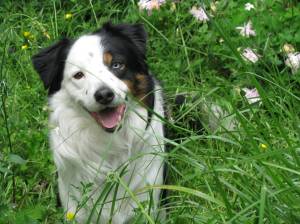
"The Pie" looking gorgeous!
Yes he has one blue eye! whenever we are out everyone comments “he has one blue eye” I wonder if they think I hadn’t noticed before then? 🙂 When we were in Italy I even learnt to understand that phrase in Italian so not just brits that notice!
I assure you he can see with both eyes just the same and I chose him because there was a good chance he would have a blue eye!
Puppy rules or how to live with a puppy!
October 21, 2009
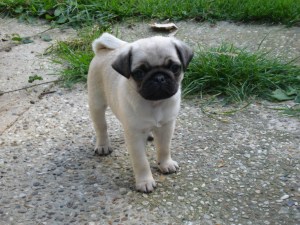
Arabella's puppy now doing well in the show ring!
Dogs are pack animals, which is why they live so well with us in our family units, which to them equates to the ‘pack’. The most successful packs in the wild are those where there are clear rules, boundaries and constraints; every dog knows its job and what it can and can’t do. Their survival depends upon clear rules and consistency. This in itself offers the dog a sense of security.
To give a dog the best possible start within our ‘pack’, we too need to clearly outline and instigate rules and boundaries. Without these, our dog begins to display unwanted behaviours such as play-biting, jumping up uninvited, stealing and behaving like a real ‘wild child’! Often we try to fix the actual problem but the underlying causes remain the same and the behaviour never really disappears.
Here is my list of suggested rules, which would remain in place until the dog is at least 2 years old:
- Restricting the dog’s area when he or she is left alone
- Not allowing the dog on furniture
- Ensuring the dog moves out of our way when required – not us stepping over the dog or around it
- No one is to play rough or ‘fighting’ games with the dog
- Do not allow the dog to play fight/play bite with other dogs living in the household
- No ‘tug of war’ games with the dog
- No jumping up uninvited
- No feeding the dog from the table or plates
- All food and titbits should be ‘worked’ for, for example asking the dog to Sit for his dinner or titbit
- Not constantly responding to the dog’s demands for attention – they do not require constant entertainment
- When returning to the dog, ignoring him or her for at least 5 minutes before greeting (displays leadership skills and reduces over-excitement at your return)
Without rules and boundaries, your success in training your dog will be limited and you will not experience the true joy of a well-adjusted, well-mannered dog, which you can be justifiably proud.
If you experience problems in successfully instigating your rules or do not understand why any of the above are suggested, please contact me.


 Avril Munson's Blog